 Add to Chrome
 Add to Firefox
 Add to Edge
SIKA-GP: Accelerating Gaussian Process Inference with Sparse Inducing Kernel Approximations for Bayesian Deep Learning
May 26, 2026
Gaussian processes (GPs) provide a principled Bayesian framework for uncertainty estimation, but their computational complexity severely limits scalability to large datasets. We propose SIKA-GP, which accelerates GP inference using sparse inducing kernel approximations based on a dyadic ordered template basis, incurring only ${O}(\log M)$ complexity dependence on the number of inducing points. Our approach constructs compact and expressive kernel representations from sparsely activated bases, enabling efficient tensorized GPU computation and seamless integration with modern large-scale models. SIKA-GP can be naturally embedded into Bayesian neural networks (BNNs) with sparse activations, yielding significant speedups in both training and inference without sacrificing predictive performance. The method naturally extends to deep feature learning, addressing the scalability challenges introduced by deep architectures and high-dimensional feature representations. Empirical results on vision and transformer-based language benchmarks demonstrate that our approach consistently delivers fast and accurate GP models, providing a principled path toward scalable kernel learning.

Trust It or Not: Evidential Uncertainty for Feed-Forward 3D Reconstruction with Trust3R
May 19, 2026Geometric foundation models hold promise for unconstrained dense geometry prediction from uncalibrated images. However, in current feed-forward designs, their predicted confidence scores are heuristic, lack probabilistic interpretation, and often fail to indicate where and how much the predicted geometry can be trusted. To address this gap, we present Trust3R, a lightweight evidential uncertainty framework for feed-forward 3D reconstruction. Trust3R combines gated residual mean refinement with a Normal-Inverse-Wishart evidential head, yielding a closed-form multivariate Student-t distribution for per-point geometric uncertainty. This design provides probabilistically grounded pointmap uncertainty estimates while adding moderate inference overhead. We evaluate on diverse indoor and outdoor benchmarks and compare against MASt3R's built-in confidence map as well as common uncertainty-aware baselines spanning single-pass heteroscedastic regression and sampling-based methods such as MC dropout and deep ensembles. Experimental results show that Trust3R consistently improves risk-coverage and sparsification, and generally improves geometric accuracy. These gains are reflected in stronger uncertainty ranking across benchmarks, with 25% lower AURC and 41% lower AUSE on ScanNet++, providing a practical reliability signal for uncertainty-aware weighting in downstream geometry pipelines. The project page and code are available at https://trust3r-z.github.io/.
Optimal Multi-bit Generative Watermarking Schemes Under Worst-Case False-Alarm Constraints
Apr 09, 2026This paper considers the problem of multi-bit generative watermarking for large language models under a worst-case false-alarm constraint. Prior work established a lower bound on the achievable miss-detection probability in the finite-token regime and proposed a scheme claimed to achieve this bound. We show, however, that the proposed scheme is in fact suboptimal. We then develop two new encoding-decoding constructions that attain the previously established lower bound, thereby completely characterizing the optimal multi-bit watermarking performance. Our approach formulates the watermark design problem as a linear program and derives the structural conditions under which optimality can be achieved. In addition, we identify the failure mechanism of the previous construction and compare the tradeoffs between the two proposed schemes.
Fusing in 3D: Free-Viewpoint Fusion Rendering with a 3D Infrared-Visible Scene Representation
Jan 19, 2026Infrared-visible image fusion aims to integrate infrared and visible information into a single fused image. Existing 2D fusion methods focus on fusing images from fixed camera viewpoints, neglecting a comprehensive understanding of complex scenarios, which results in the loss of critical information about the scene. To address this limitation, we propose a novel Infrared-Visible Gaussian Fusion (IVGF) framework, which reconstructs scene geometry from multimodal 2D inputs and enables direct rendering of fused images. Specifically, we propose a cross-modal adjustment (CMA) module that modulates the opacity of Gaussians to solve the problem of cross-modal conflicts. Moreover, to preserve the distinctive features from both modalities, we introduce a fusion loss that guides the optimization of CMA, thus ensuring that the fused image retains the critical characteristics of each modality. Comprehensive qualitative and quantitative experiments demonstrate the effectiveness of the proposed method.
Modality-Decoupled RGB-Thermal Object Detector via Query Fusion
Jan 13, 2026The advantage of RGB-Thermal (RGB-T) detection lies in its ability to perform modality fusion and integrate cross-modality complementary information, enabling robust detection under diverse illumination and weather conditions. However, under extreme conditions where one modality exhibits poor quality and disturbs detection, modality separation is necessary to mitigate the impact of noise. To address this problem, we propose a Modality-Decoupled RGB-T detection framework with Query Fusion (MDQF) to balance modality complementation and separation. In this framework, DETR-like detectors are employed as separate branches for the RGB and TIR images, with query fusion interspersed between the two branches in each refinement stage. Herein, query fusion is performed by feeding the high-quality queries from one branch to the other one after query selection and adaptation. This design effectively excludes the degraded modality and corrects the predictions using high-quality queries. Moreover, the decoupled framework allows us to optimize each individual branch with unpaired RGB or TIR images, eliminating the need for paired RGB-T data. Extensive experiments demonstrate that our approach delivers superior performance to existing RGB-T detectors and achieves better modality independence.
Partial Information Decomposition via Normalizing Flows in Latent Gaussian Distributions
Oct 06, 2025The study of multimodality has garnered significant interest in fields where the analysis of interactions among multiple information sources can enhance predictive modeling, data fusion, and interpretability. Partial information decomposition (PID) has emerged as a useful information-theoretic framework to quantify the degree to which individual modalities independently, redundantly, or synergistically convey information about a target variable. However, existing PID methods depend on optimizing over a joint distribution constrained by estimated pairwise probability distributions, which are costly and inaccurate for continuous and high-dimensional modalities. Our first key insight is that the problem can be solved efficiently when the pairwise distributions are multivariate Gaussians, and we refer to this problem as Gaussian PID (GPID). We propose a new gradient-based algorithm that substantially improves the computational efficiency of GPID based on an alternative formulation of the underlying optimization problem. To generalize the applicability to non-Gaussian data, we learn information-preserving encoders to transform random variables of arbitrary input distributions into pairwise Gaussian random variables. Along the way, we resolved an open problem regarding the optimality of joint Gaussian solutions for GPID. Empirical validation in diverse synthetic examples demonstrates that our proposed method provides more accurate and efficient PID estimates than existing baselines. We further evaluate a series of large-scale multimodal benchmarks to show its utility in real-world applications of quantifying PID in multimodal datasets and selecting high-performing models.
Learning A Robust RGB-Thermal Detector for Extreme Modality Imbalance
May 28, 2025RGB-Thermal (RGB-T) object detection utilizes thermal infrared (TIR) images to complement RGB data, improving robustness in challenging conditions. Traditional RGB-T detectors assume balanced training data, where both modalities contribute equally. However, in real-world scenarios, modality degradation-due to environmental factors or technical issues-can lead to extreme modality imbalance, causing out-of-distribution (OOD) issues during testing and disrupting model convergence during training. This paper addresses these challenges by proposing a novel base-and-auxiliary detector architecture. We introduce a modality interaction module to adaptively weigh modalities based on their quality and handle imbalanced samples effectively. Additionally, we leverage modality pseudo-degradation to simulate real-world imbalances in training data. The base detector, trained on high-quality pairs, provides a consistency constraint for the auxiliary detector, which receives degraded samples. This framework enhances model robustness, ensuring reliable performance even under severe modality degradation. Experimental results demonstrate the effectiveness of our method in handling extreme modality imbalances~(decreasing the Missing Rate by 55%) and improving performance across various baseline detectors.
Fréchet Power-Scenario Distance: A Metric for Evaluating Generative AI Models across Multiple Time-Scales in Smart Grids
May 12, 2025Generative artificial intelligence (AI) models in smart grids have advanced significantly in recent years due to their ability to generate large amounts of synthetic data, which would otherwise be difficult to obtain in the real world due to confidentiality constraints. A key challenge in utilizing such synthetic data is how to assess the data quality produced from such generative models. Traditional Euclidean distance-based metrics only reflect pair-wise relations between two individual samples, and could fail in evaluating quality differences between groups of synthetic datasets. In this work, we propose a novel metric based on the Fr\'{e}chet Distance (FD) estimated between two datasets in a learned feature space. The proposed method evaluates the quality of generation from a distributional perspective. Empirical results demonstrate the superiority of the proposed metric across timescales and models, enhancing the reliability of data-driven decision-making in smart grid operations.
Optimizing Leaky Private Information Retrieval Codes to Achieve ${O}(\log K)$ Leakage Ratio Exponent
Jan 21, 2025We study the problem of leaky private information retrieval (L-PIR), where the amount of privacy leakage is measured by the pure differential privacy parameter, referred to as the leakage ratio exponent. Unlike the previous L-PIR scheme proposed by Samy et al., which only adjusted the probability allocation to the clean (low-cost) retrieval pattern, we optimize the probabilities assigned to all the retrieval patterns jointly. It is demonstrated that the optimal retrieval pattern probability distribution is quite sophisticated and has a layered structure: the retrieval patterns associated with the random key values of lower Hamming weights should be assigned higher probabilities. This new scheme provides a significant improvement, leading to an ${O}(\log K)$ leakage ratio exponent with fixed download cost $D$ and number of servers $N$, in contrast to the previous art that only achieves a $\Theta(K)$ exponent, where $K$ is the number of messages.
Path-Guided Particle-based Sampling
Dec 04, 2024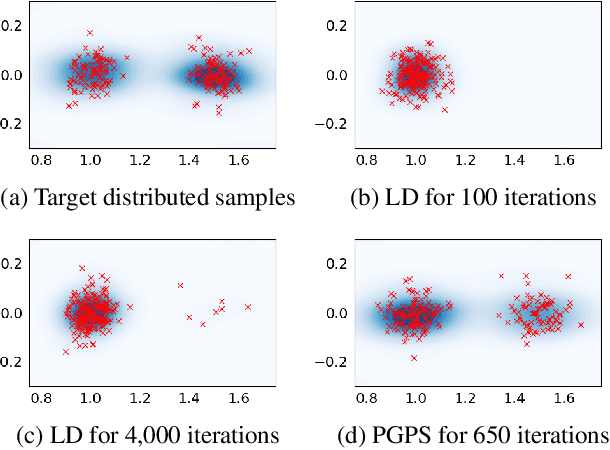

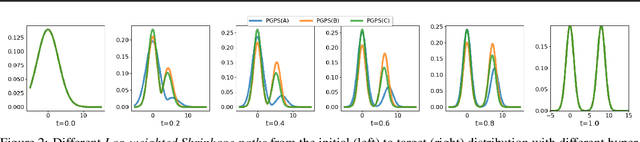
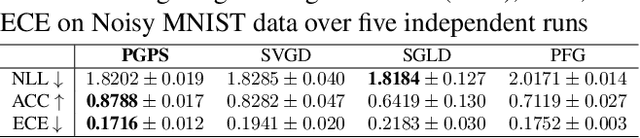
Particle-based Bayesian inference methods by sampling from a partition-free target (posterior) distribution, e.g., Stein variational gradient descent (SVGD), have attracted significant attention. We propose a path-guided particle-based sampling~(PGPS) method based on a novel Log-weighted Shrinkage (LwS) density path linking an initial distribution to the target distribution. We propose to utilize a Neural network to learn a vector field motivated by the Fokker-Planck equation of the designed density path. Particles, initiated from the initial distribution, evolve according to the ordinary differential equation defined by the vector field. The distribution of these particles is guided along a density path from the initial distribution to the target distribution. The proposed LwS density path allows for an efficient search of modes of the target distribution while canonical methods fail. We theoretically analyze the Wasserstein distance of the distribution of the PGPS-generated samples and the target distribution due to approximation and discretization errors. Practically, the proposed PGPS-LwS method demonstrates higher Bayesian inference accuracy and better calibration ability in experiments conducted on both synthetic and real-world Bayesian learning tasks, compared to baselines, such as SVGD and Langevin dynamics, etc.